


Real estate is one of the most trusted ways to build long-term wealth in the US.
For beginners, however, it can feel confusing and risky.
Prices change. Markets shift. Advice often conflicts.
This guide breaks down real estate investment strategies for beginners in a simple way.
You will learn how different strategies work, what risks to expect, and how to start smart.
Think of real estate like planting a tree.
With the right soil, patience, and care, it can grow for decades.
This article helps you choose the right seed.
What Is Real Estate Investing?
Real estate investing means buying property to earn money.
Income can come from rent, appreciation, or both.
Two Main Ways Investors Make Money
Cash flow
Monthly rental income after expenses
Appreciation
Property value increases over time
Many beginners focus only on appreciation.
Smart investors balance both.
Why Real Estate Is Good for Beginners
Real estate offers stability compared to stocks.
It is tangible and easier to understand.
Key Benefits
Predictable income
Tax advantages
Inflation protection
Leverage using loans
Long-term wealth growth
Example:
A rental home bought in 2015 may earn rent monthly and double in value by 2025.

Real Estate Investment Strategies for Beginners
There is no single best strategy.
Your budget, time, and risk tolerance matter.
Below are the most beginner-friendly real estate investment strategies.
1. Buy and Hold Strategy
What Is Buy and Hold?
You buy a property and rent it long-term.
You hold it for years while collecting rent.
Why Beginners Love It
Simple to manage
Steady monthly income
Long-term appreciation
Example
Sarah buys a $250,000 duplex.
She rents both units.
Rent covers the mortgage and expenses.
Over time, equity grows.
Pros
Passive income
Lower risk
Easy financing
Cons
Requires patience
Property management needed
2. House Hacking
What Is House Hacking?
You live in one part of the property.
You rent out the rest.
Common House Hacking Options
Duplex or triplex
Single home with extra rooms
Basement or garage apartment
Why It Works
Lowers living expenses
Qualifies for owner-occupied loans
Ideal for first-time buyers
Example
Mike buys a four-unit property.
He lives in one unit.
Rent from others covers most costs.
House hacking is one of the smartest real estate investment strategies for beginners with limited cash.
3. Fix and Flip Strategy
What Is Fix and Flip?
You buy a distressed property.
You renovate and sell it quickly.
When It Works Best
Strong local housing demand
Accurate repair estimates
Fast project execution
Example
Buy price: $180,000
Renovation: $40,000
Sale price: $270,000
Pros
Quick profits
No long-term commitment
Cons
High risk
Market timing matters
Renovation surprises
This strategy suits beginners with construction knowledge.
4. Short-Term Rentals (Airbnb)
What Are Short-Term Rentals?
Properties rented nightly or weekly.
Common on Airbnb or Vrbo.
Why Beginners Try It
Higher income potential
Flexible usage
Key Considerations
Local regulations
Seasonal demand
Active management
Example
A beach condo earns triple summer income.
Winter bookings drop.
Short-term rentals work best in tourist areas.
5. Real Estate Investment Trusts (REITs)
What Are REITs?
Companies that own income-producing properties.
You buy shares like stocks.
Why REITs Are Beginner-Friendly
No property management
Low entry cost
High liquidity
Types of REITs
Residential
Commercial
Healthcare
Data centers
REITs are great for passive investors.
6. Wholesaling Real Estate
What Is Wholesaling?
You find discounted properties.
You sell the contract to another investor.
Why It Appeals to Beginners
No property ownership
Low capital required
Risks
Requires strong negotiation
Legal rules vary by state
Wholesaling focuses more on marketing than ownership.
Choosing the Right Strategy
Choosing a strategy is like choosing a vehicle.
Some are fast. Some are steady.
Ask Yourself
How much capital do I have?
How much time can I commit?
How much risk can I handle?
Beginner Strategy Comparison
Strategy Risk Time Capital
Buy and Hold Low Medium Medium
House Hacking Low Medium Low
Fix and Flip High High High
REITs Low Low Low
How Much Money Do You Need to Start?
You do not need millions.
Many beginners start with FHA loans.
Common Entry Options
FHA loan (3.5% down)
VA loan (0% down)
Conventional loan (5–20% down)
REITs ($100+)
Example:
A $300,000 home with FHA needs $10,500 down.
Understanding Real Estate Financing
Financing multiplies your buying power.
Common Loan Types
FHA loans
Conventional loans
Hard money loans
Private lenders
Key Terms to Know
Interest rate
Down payment
Cash-on-cash return
Loan-to-value ratio
Leverage is powerful but risky if misused.
Key Risks Beginners Must Know
Every investment has risk.
Ignoring risk is the fastest way to lose money.
Major Real Estate Risks
Market downturns
Vacancy
Repairs
Bad tenants
Interest rate hikes
How to Reduce Risk
Buy below market value
Maintain cash reserves
Screen tenants carefully
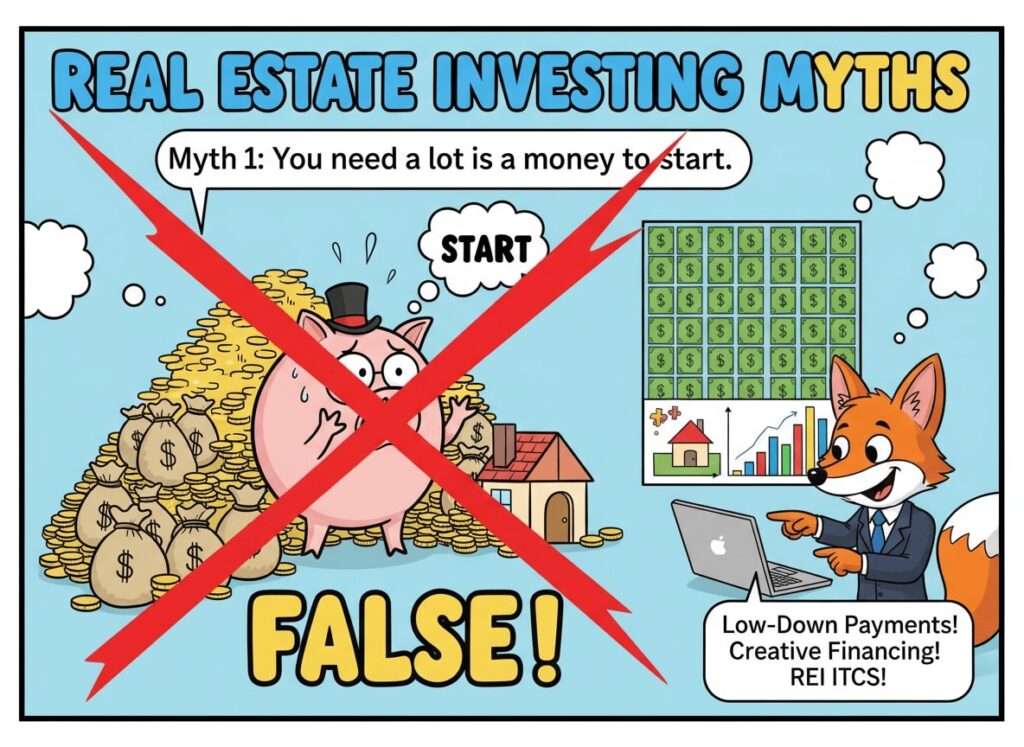
Real Estate Investing Myths
Myth 1: You Need a Lot of Money
Reality: Many start with low down payments.
Myth 2: Real Estate Is Passive
Reality: It requires management.
Myth 3: All Markets Perform the Same
Reality: Location matters more than price.
Building a Beginner Real Estate Team
You do not invest alone.
Key People to Know
Real estate agent
Lender
Property inspector
Accountant
Property manager
A good team saves time and money.
Tax Benefits for US Investors
Real estate offers unique tax advantages.
Common Tax Benefits
Depreciation
Mortgage interest deduction
1031 exchanges
Expense write-offs
Always consult a licensed tax professional.
Beginner Mistakes to Avoid
Learning from others saves money.
Common Mistakes
Overpaying
Skipping inspections
Ignoring cash flow
No exit plan
Smart investors plan for worst-case scenarios.
How to Start Today (Step-by-Step)
Set investment goals
Check credit score
Learn local market
Choose one strategy
Get pre-approved
Analyze deals
Take action
Small steps lead to big results.
Key Takeaways
Real estate builds long-term wealth
Beginners should start simple
Buy and hold is the safest strategy
House hacking lowers risk
Education reduces costly mistakes
Consistency matters more than speed.
Frequently Asked Questions (FAQs)
1. Is real estate good for beginners?
Yes.
It offers predictable income and long-term growth.
2. What is the safest real estate strategy?
Buy and hold rentals in stable markets.
3. How much money do beginners need?
Some start with under $15,000 using FHA loans.
4. Can I invest without owning property?
Yes.
REITs allow indirect investing.
5. Is real estate risky during recessions?
Risk exists, but housing remains essential.
Disclaimer
This article is for educational purposes only.
It is not financial or legal advice.
Always consult licensed professionals before investing.
Call to Action (CTA)
Ready to start your real estate journey?
Begin by researching your local market today.
The best time to learn was yesterday.
The second-best time is now.
If you want, I can also:
Optimize this for featured snippets
Add internal linking suggestions
Create conversion-focused CTAs
Adapt it for WordPress or Medium
Provide SEO keyword density analysis
Just tell me 👍
